Boron

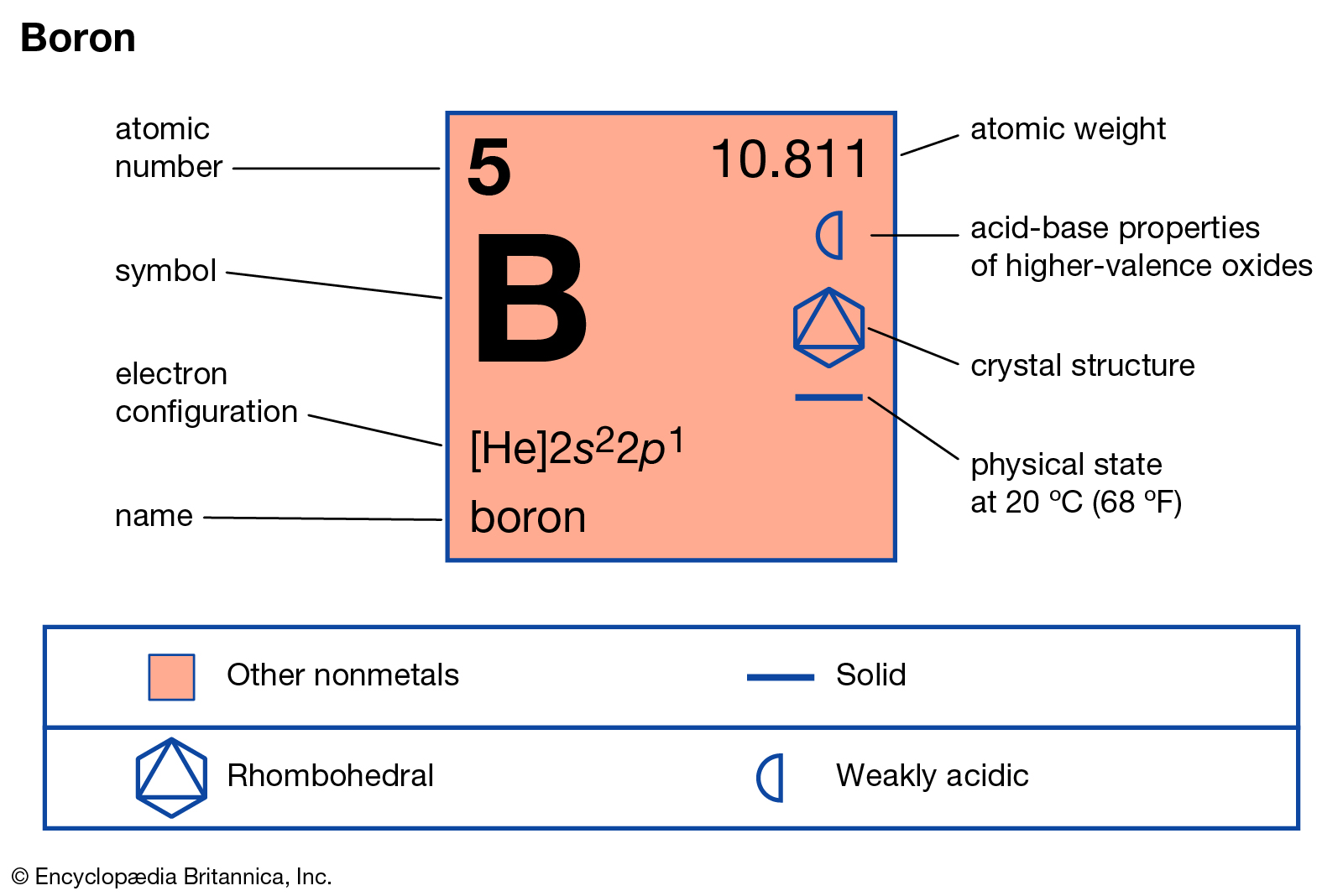
Atomic Number: 5
Symbol: B
Atomic Mass: 10.811 u
Number of Neutrons: 6
Melting Point: 2076°C
Boiling Point: 3927°C
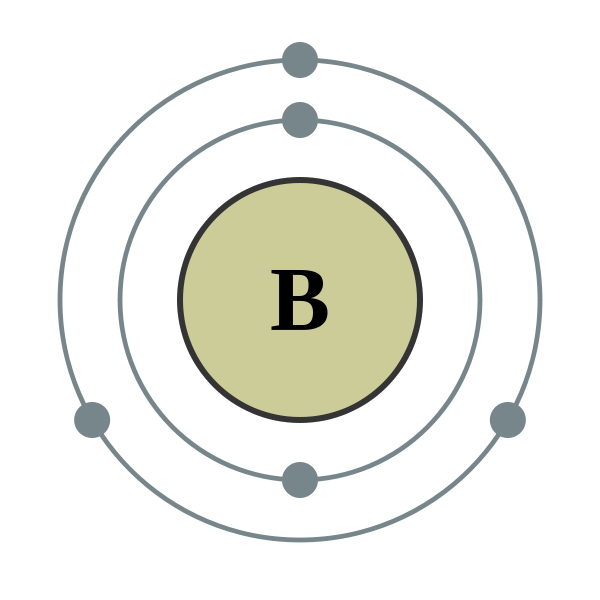
Electrons per shell: 2.3
Ion charge: 3+
Electron configuration: 1s2 2s2 2p1


Boron is the 5th element in the periodic table, and it is a metaloid. Boron is very hard, and tough. It can resist heat very well, and is not found by itself. This element is found in the earths crust near volcanoes in ores such as borax, rasorite and colemanite. These ores can be found in Turkey, and the Mojave Desert in California, USA. Boron has 14 isotopes and two stable isotopes, boron-10 (is 19.9% of boron) and boron-11 (is 80.1% of boron). It is used in rockets, and in firework flares and it can be helpful for our body as well. It is very good for bones and joints. Louis-Josef Gay-Lussac and Louis-Jacques Thénard in France, and Humphry Davy in London discovered this element. The name is derived from the Arabic 'buraq', which was the name for borax.

Previous Element  Next Element

References

“Boron.” Wikipedia, Wikimedia Foundation, 29 Nov. 2020, en.wikipedia.org/wiki/Boron.

“Water Treatment Solutions.” Lenntech Water Treatment & Purification, www.lenntech.com/periodic/elements/b.htm.

The Editors of Encyclopaedia Britannica. “Boron | Properties, Uses, & Facts | Britannica.” Britannica, www.britannica.com/science/boron-chemical-element.

“Boron | Properties and Applications | Materials Hub.” Material Shub, www.materialshub.com/material/boron/.

Schlink, Erin. “See the Electron Configuration Diagrams for Atoms.” Pinterest, www.pinterest.com/pin/175218241740488890/.