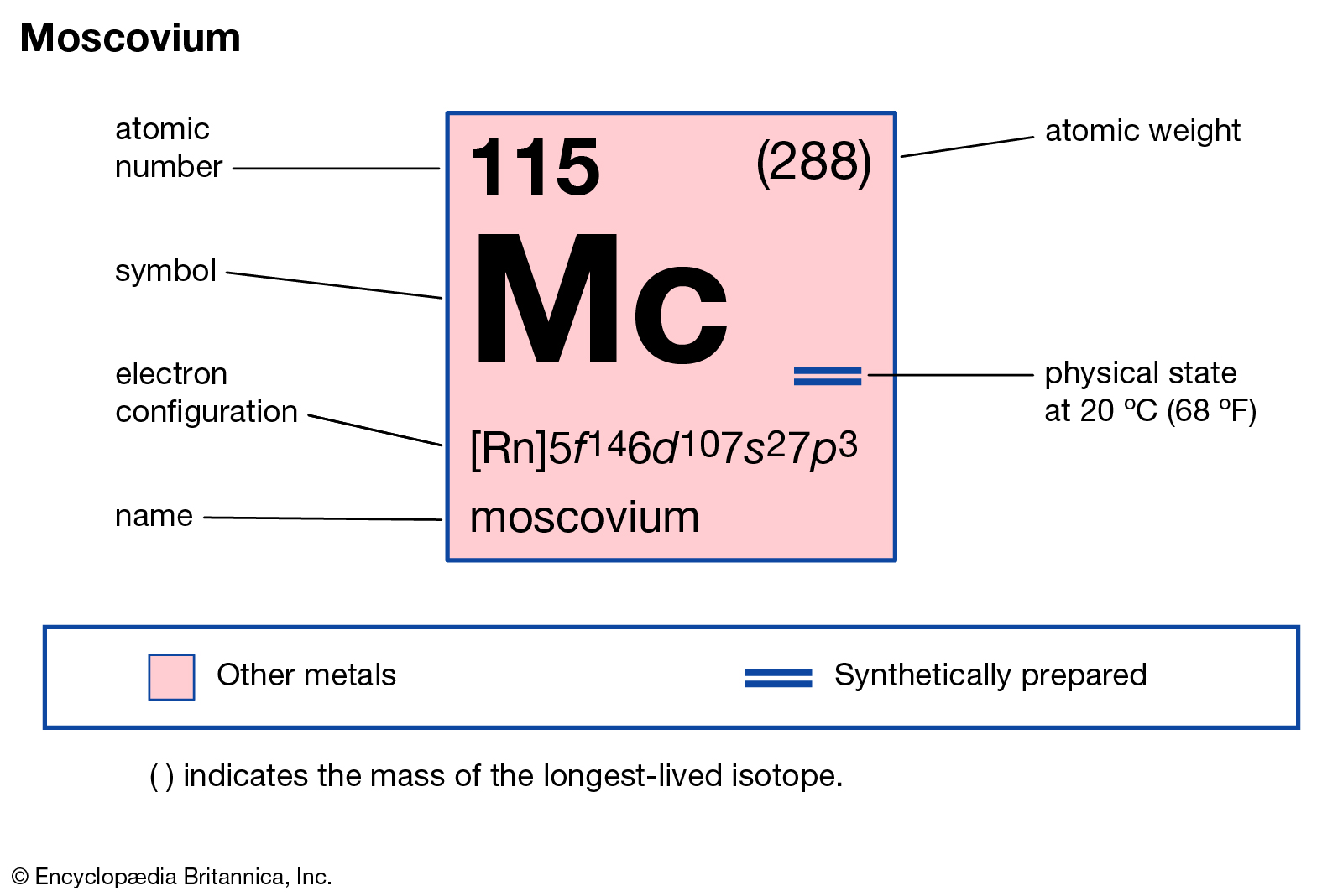
Moscovium
Atomic Number: 115
Moscovium is the 115th element in the periodic table and it is predicted to be a post-transition metal. It is a radioactive element with only 5 known isotopes. The most stable isotope is moscovium-290 which has a half-life of only 0.65 seconds. It had a temporary name called ununpentium which means one-one-five in latin. It is estimated to be a solid at room temperature with an unknown appearence. This element has no use other than research because only a few atoms have ever been made. Though, it is used to make nihonium. This element is an artificial element which means it is not naturally. To make moscovium you need to bombard atoms of americium with ions of calcium in a cyclotron (a type of particle accelerator). This produces atoms of moscovium, which quickly decays and makes the element nihonium. Moscovium was disocvered by using this method by two teams, the Joint Institute for Nuclear Research in Dubna, Russia and the Lawrence Livermore National Laboratory in California. This collaboration between science teams led by Yuri Oganessian and Ken Moody was revolutionary in 2003. This element is named after Moscow, the capital of Russia. |
|