Roentgenium
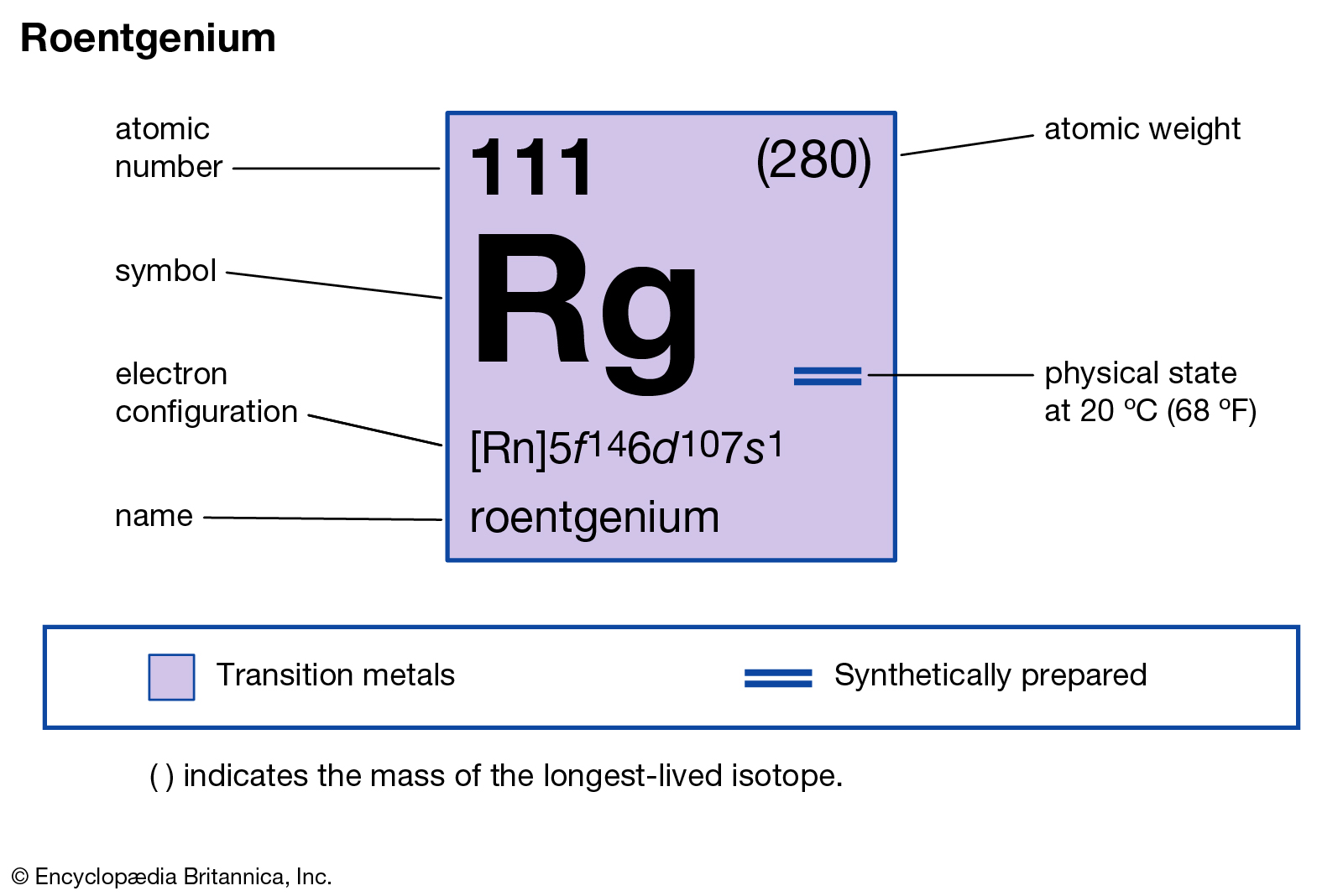
Atomic Number: 111
Roentgenium is the 111th element in the periodic table and it is predicted to be a transition metal. There isn't much known about this element because only a few atoms of it have ever been made. It's appearence is unknown but it would be orange metallic or yellow in color. It is also not sure what state it is in at room temperature, but it is predicted to be a solid. This element has 12 known isotopes which are all unstable. The most stable isotope is roentgenium-281, with a half-life of 23 seconds. It is an extremely radioactive synthetic element that can be created in a lab but is not found in nature. Roentgenium is produced by bombarding bismuth-209 with nickel-64 in a heavy ion particle accelerator. The element was discovered by a team led by Peter Armbruster and Gottfried Münzenber in 1994 by using this method. Roentgenium is named after scientist, Wilhelm Conrad Röentgen, who discovered X-rays. |
|