Hassium
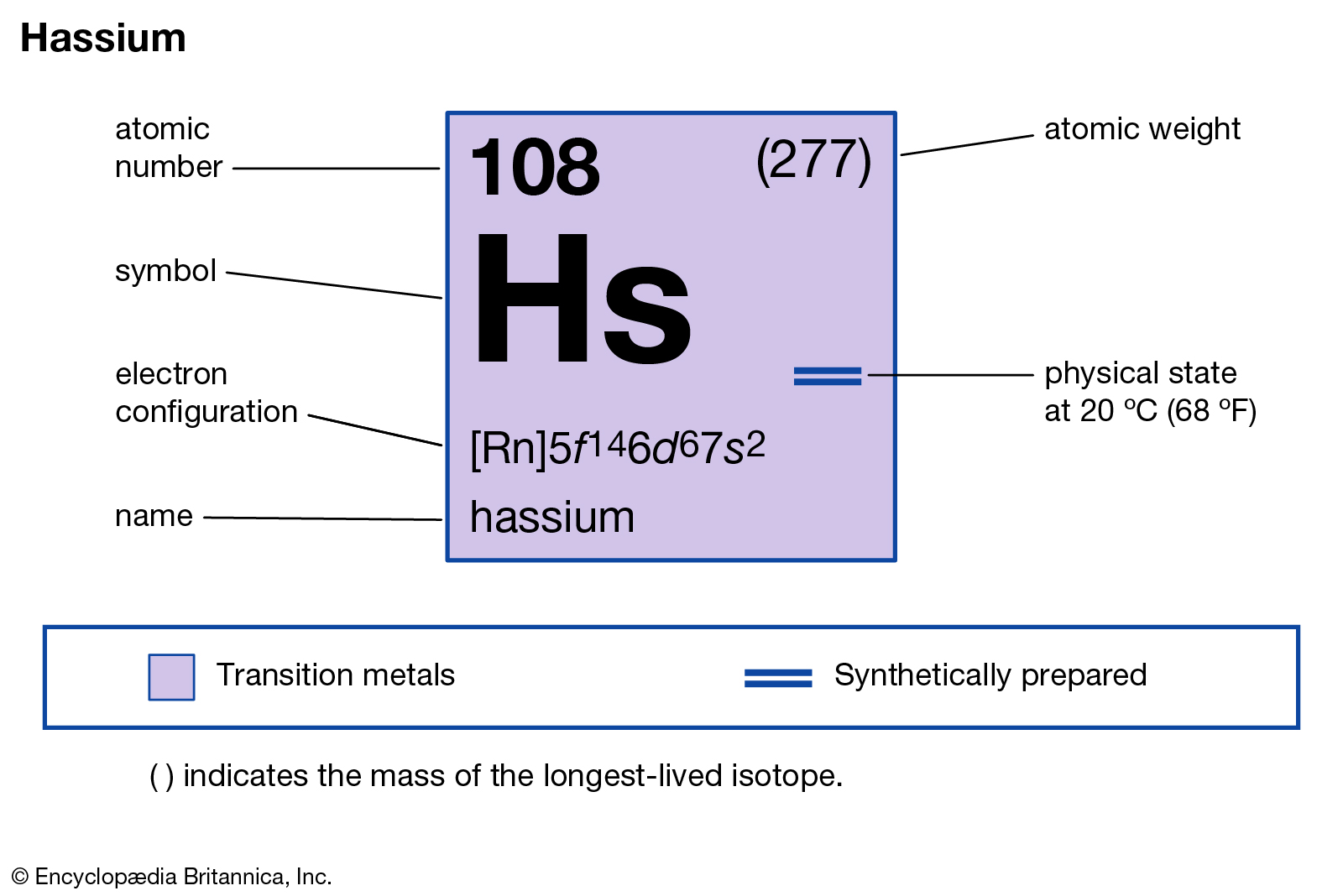
Atomic Number: 108
Hassium is the 108th element in the periodic table and it is the last known transition metal in row 7 and in the whole of the periodic table. It is highly radioactive, just like many of the other elements with high atomic numbers. Hassium is predicted to be solid and doesn't have a known appearence. Only a few atoms of this element have ever been made so there is no use for it other than research. It's most stable known isotopes have half-lives of approximately ten seconds. It is a synthetic element which means that it is not found naturally and needs to be made in the lab. It is made through bombarding atoms of lead-208, with ions of iron-58. This process is done in a particle accelerator and creates hassium-265 and a free neutron. It was first discovered in Darmstadt, Germany, by Peter Armbruster and Gottfried Münzenber in 1984. The name hassium is derived from the German state of Hesse where Hassium was first made. |
|