Dubnium
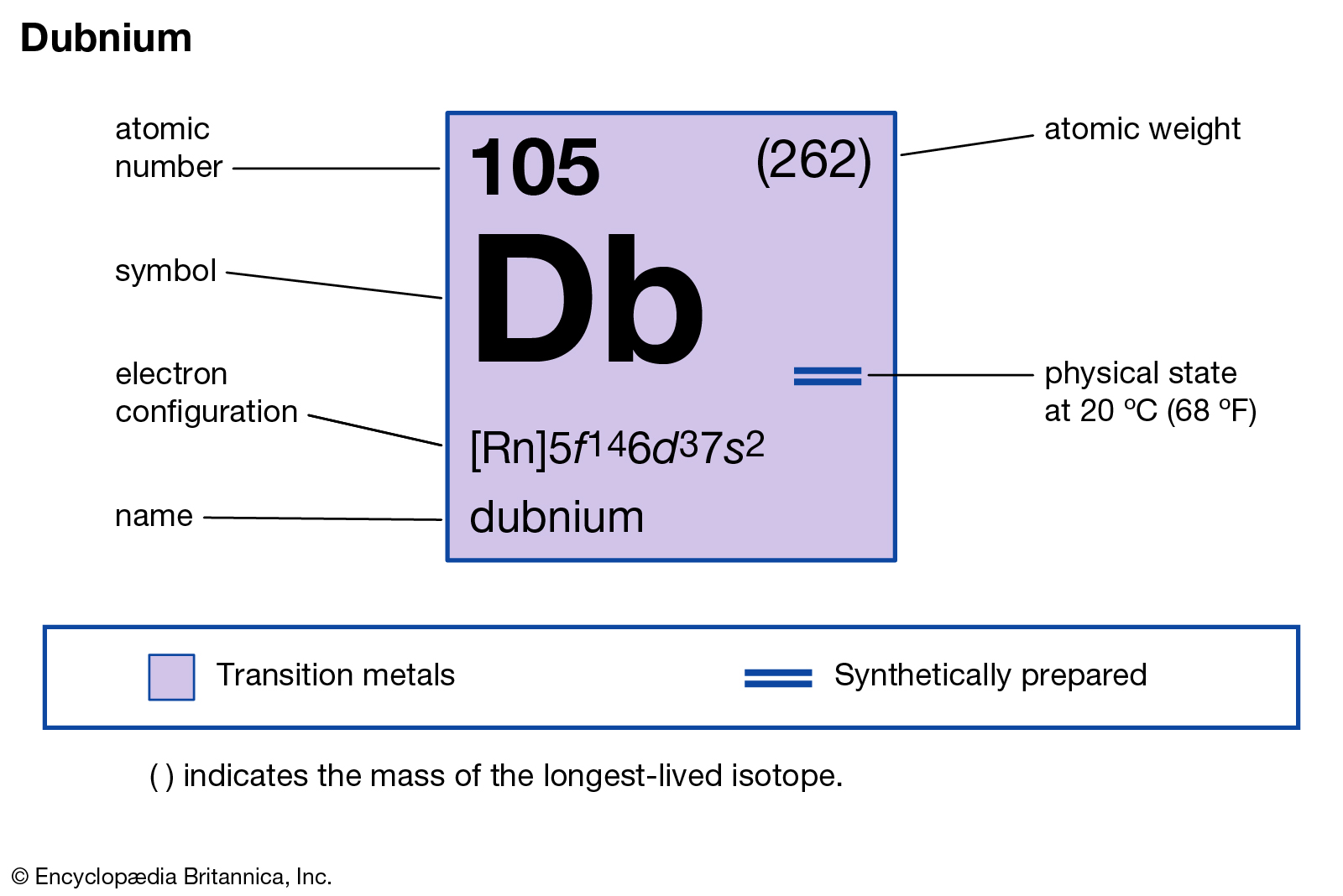
Atomic Number: 105
Dubnium is the 105th element in the periodic table and it is the second transition metal. It is a highly radioactive metal, of which only a few atoms have ever been made. It is estimated that it is a solid, but scienctists do not know yet. It has no uses other than research due to it being very hard to make. It also has no known biological role. Dubnium is an artificial element which means it is not found naturally and has to be made in a lab. It is made by bombarding californium-249 with nitrogen. It can also be produced by bombarding americium-243 with neon. These two processes happen in particle accelerators. There are 7 known isotopes and the isotope with the highest half-life is dubnium-268 with a 28 hour half-life. In 1968, a team led by Georgy Flerov at the Russian Joint Institute for Nuclear Research discovered dubnium. It is named for Dubna, Russia, home of the Joint Institute for Nuclear Research. Though, some scientists discovered this element as well and wanted it to be called "hahnium" after the German scientist Otto Hahn. |
|